
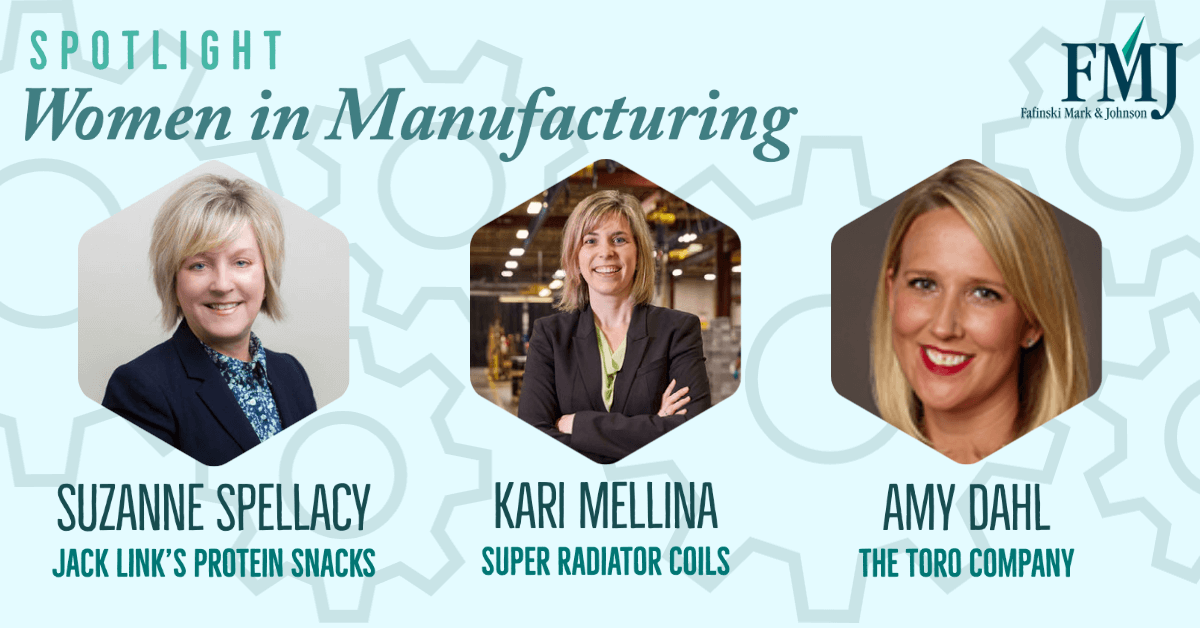
The below piece was written by Jim Seifert, head of our Manufacturing practice group.
As a long-time veteran of the manufacturing industry and head of FMJ’s Manufacturing practice group, I thought it was important to shed light on some statistics regarding women in manufacturing and highlight a few phenomenal women in manufacturing leadership roles in honor of Women’s History Month.
The Women in Manufacturing (WiM) Association and the Thomas Network compiled a Women in Manufacturing Benchmark Study that was released in December 2020. Here are some of its findings:
- Only 1 in 3 manufacturing professionals and 1 in 4 manufacturing leaders are women.
- The Medical/Healthcare industry has the highest female employee presence whereas Aerospace & Defense has the lowest representation.
- Female employee representation is strongly and positively correlated with female leadership presence suggesting that a gender-balanced environment fosters more diverse leadership, (and vice versa).
- Women are significantly less likely to report that their contributions are valued in manufacturing businesses and less likely to receive career advancement opportunities.
- Professionals in the Medical/Healthcare and Agricultural industries are the most optimistic about the advancement of women in manufacturing.
- Associations and mentorships are most helpful to women in manufacturing.
- The majority of respondents agree women have made significant progress in the manufacturing industry over the last five years.
How Can We Improve These Numbers
What are WiM’s recommendations to ensure women continue to provide their tremendous contributions to the manufacturing industry?
- Companies should invest in resources, training, and/or association partnerships.
- Increase mentorship opportunities.
- Leverage association memberships or other network opportunities to find qualified female candidates instead of relying on traditional hiring practices.
- Focus on adding or creating a balance of the most desired benefits, such as transportation/commuting allowance, flexible work schedule, on-site childcare, paid paternity leave, and paid medical leave.
Spotlights
I reached out to several women in the industry to explore their careers in manufacturing, their perspective on what makes a successful manufacturing company, and advice they have for women starting out in the industry.
Suzanne Spellacy – General Counsel, Jack Link’s Protein Snacks
How did you get your start in manufacturing and why do you continue to choose a career in the industry?
Answer: My career in manufacturing started when I returned to my hometown of Mankato, Minnesota to work as an attorney for Taylor Corporation. I loved the fact that we produced great products used around the world with our headquarters still in southern Minnesota. It’s very fulfilling to know that the company I work for is producing products people use every day.
In your opinion, what are three key components to a successful manufacturing company?
Answer:
1.) Communicate clear goals and objectives along with metrics to track progress. When everyone in the company knows the objectives it’s amazing to see how people come together to accomplish them.
2.) Ruthlessly prioritize to make sure everyone is focusing on the activities that will drive the greatest value.
3.) Ensure disciplined execution; be accountable for delivering what you promise and ask the same of your team.
What is the proudest moment in your manufacturing career?
Answer: One experience stands out and it occurred during a particularly busy holiday season when everyone who had “desk jobs” took multiple shifts on the manufacturing floor. It was an “all hands on deck” time to ensure we could meet our customers’ needs and it was an incredibly humbling experience. The sophistication of our manufacturing processes and the skill of our experienced operators made me so proud to be part of that team!
But without question, the proudest moment personally was when Glen Taylor stopped by my office one day in 2012 and asked me to become the General Counsel of Taylor Corporation. The opportunity to serve in this role for a leading Minnesota company, headquartered in the town where I grew up, was a tremendous honor and a moment I’ll never forget.
What is a piece of advice that you could provide to women hoping to start a career in manufacturing?
Answer: Really get to know the products and processes at the heart of the company you work for or hope to work for. This will give you more insights into the business and how to use your skills to make your company more successful.
Kari Mellina – Executive Vice President and CFO, Super Radiator Coils
How did you get your start in manufacturing and why do you continue to choose a career in the industry?
Answer: Growing up, my dad was in the manufacturing field and he encouraged me to get a technical degree in college – I chose Industrial & Operations Engineering from the University of Michigan. I loved the courses on Lean Manufacturing, 5S, Quality Improvement Methods, and being hands-on during tours of auto plants and first-tier suppliers. When my dad offered me a position to learn the family business in manufacturing, I knew it was a great opportunity. I started out working in the supply chain side of the business where I was the link between the sales and engineering department and production. It was a great place to learn the business. I went back to school to earn my MBA so I could take on a leadership role in the business. Twenty-two years later, I still enjoy going on the shop floor, visiting with stakeholders in the business, and seeing how all of the activity affects the financial decisions that we make. Engineering and manufacturing coils to help our customers in industries from data cooling, food processing, military applications, and beyond are really fun and rewarding.
In your opinion, what are three (or four) key components to a successful manufacturing company?
Answer:
1.) Having a solid business model for the future – it helps to not only be product-driven but to provide an added value above the competition. Anyone can come in and beat manufacturers on price but if your business model has an extra edge (in our case engineering) you have an advantage that will make the business successful in the long term.
2.) Being agile – Lead-times, customer requirements, and sometimes products ebb and flow. Maintaining agility to move quickly to meet industry needs is necessary to be successful.
3.) Having exceptional quality in both product and delivery – Customers need to trust that the product will arrive on time and meet their specifications. It’s a must to keep customers.
4.) Maintaining a solid supply chain – you can’t sell from an empty wagon. You can’t build product from an empty one either. Maintaining supplier relationships and inventory to build from is necessary to stay agile and keep customers satisfied.
What is the proudest moment in your manufacturing career?
Answer: I think my proudest moment in my manufacturing career is when my dad and brother (the Chairman and President/CEO) approached me to take on my current role of CFO. The previous CFO decided to retire and they felt that I had the experience and aptitude to lead and grow the business with them. Its been six years since I took on the role and I have enjoyed working closely with my dad, brother, and executive team to continue to grow the business and affect our stakeholders in a positive way.
What is a piece of advice that you could provide to women hoping to start a career in manufacturing?
Answer: My advice would be to get a technical degree such as something in engineering, math, or science and then look for a position in a small to medium-sized manufacturing company. I suggest small to medium-sized because you can learn a lot very quickly by taking on a specific role while also taking on other tasks necessary to better the organization. Due to the smaller size, the mantra is a lot of times “all hands on deck” so you can absorb and learn a lot in a small amount of time. Use this opportunity to grow and build your knowledge and expertise to use in future roles that you take on.
Amy Dahl – Vice President, Human Resources & General Counsel, The Toro Company
How did you get your start in manufacturing and why do you continue to choose a career in the industry?
Answer: I was in private practice before joining The Toro Company and had the opportunity to represent clients in a variety of industries. Each client was interesting for different reasons but I always had a special affinity for my manufacturing clients because I loved learning about what they made and how they made it. I always felt a sense of connection and pride when I would see a client’s product in a store or being used, as my colleagues in our Ditch Witch business call it, “in the wild.”
Those same feelings are exponentially stronger when you are part of a manufacturing company, which is why I chose to join and why I stay at TTC. We make really important and innovative products that we sell under recognizable and valuable brands to help our customers in all of the markets we serve. Practically everyone I encounter has a story about using one of our products that they cannot wait to share. But the best part is that I am just one of more than 10,000 employees worldwide affiliated with TTC and we are looking to grow that number, especially in our manufacturing facilities.
In your opinion, what are three (or four) key components to a successful manufacturing company?
Answer: It is hard to pick just three but, without question, the first is people. From the first person who designs a product, to the last person who touches it on the manufacturing line before delivery to a customer, it is our people who make it all happen. Needless to say, in this environment, the competition for talent is fierce, especially among skilled workers.
Next is a commitment to innovation. That might mean different things to different companies but for us at TTC it is about truly and deeply understanding the needs and challenges of our customers and developing superior solutions to help solve them.
Finally, it is culture. You need to have a culture that attracts and keeps the people that make it all happen, and fosters the innovation that will drive profitable growth. At TTC, our values-based culture is the foundation upon which we have built our past success and is a strategic differentiator that is key to our ongoing and future success.
What is the proudest moment in your manufacturing career?
Answer: My proudest and the most humbling moment was in 2015 when I was named Vice President, Human Resources at TTC. With the support of our then CEO and Board, I was given the incredible opportunity to lead an amazing team of HR professionals as we re-envisioned and reshaped the function in ways to best serve our growing and evolving organization and each employee. I also joined the executive leadership team at that time and for the last six years have had the privilege of helping to establish the strategic priorities and long-term direction for our company while also executing on near-term performance. I was equally honored in 2020 to come full circle and return to TTC’s legal department in the role as its General Counsel. Lastly, another career highlight was serving as the Chair of the Committee responsible for celebrating The Toro Company’s Centennial in 2014. We are now approaching our 107-year mark and the best is yet to come for TTC and all of its stakeholders.
What is a piece of advice that you could provide to women hoping to start a career in manufacturing?
Answer: As a woman in manufacturing, you are special! Did you know that women make up about 50% of the general population but less than 30% of employees in manufacturing? As I previously noted, this is an industry where innovation is essential to growth and success, and by its nature innovation requires diversity of thought, perspective, and experience. You bring a unique point of view and should never be afraid to ask a question or speak up, even if you are the only female voice in the room.
In addition, the opportunities in a manufacturing company are practically endless! When I joined TTC, I had a very traditional and narrow view of my career path and possibilities. I never imagined that I would have the opportunity to move out of the legal department, report to the CFO, and represent the company to analysts and shareholders in an investor relations role. I never dreamed that I would be asked to lead the HR function without having substantive expertise in that field. I hoped that one day I might have the opportunity to be the company’s Chief Legal Officer. Each move involved some element of risk and hesitation but also exciting opportunities to learn, grow, and help others learn and grow! Of course, in each instance, I was fortunate to have unwavering leadership, peer, and team support.
Related Attorneys
